Development of Wood Preservatives
Wood decay has plagued humans since they began building with wood thousands of years ago. When trees with natural durability were available, they were commonly used. But the scarcity of durable timbers in some areas of the world, coupled with a need to make our wood products and structures last longer, led us to develop techniques to preserve wood.
Charring is perhaps the oldest wood preserving technique, first done over 4,000 years ago by plunging round stakes in fire. The Temple of Diana at Ephesus in ancient Greece was built on charred wooden piles. Throughout the centuries, just about every new chemical discovered has been tried as a wood preservative. The Greeks poured oil into bored holes to preserve the pillars supporting buildings. Vegetable and mineral oils were used to preserve wood by several early peoples, including Romans, Chinese, Burmese, Greeks and Egyptians.
Impregnating wood with chemicals using vacuum and pressure processes started in 183 1 with a French invention, making it possible to test thousands of chemicals as preservatives. The testing of new chemical formulations is a never-ending process. Despite this effort, very few new chemicals are suitable for today's wood preserving needs.
The science of wood preservation could be defined as the process of adding adequate quantities and concentrations of toxic or repellent substances to a given wood product to upgrade its resistance to biological attack and make it highly durable.
Carrier Liquids or Solvents
Preservatives are used in liquid form. They rely on solvents to carry the toxic chemicals into the wood during impregnation. Each wood-preserving chemical has its own unique properties, like solubility and boiling range. In practice, therefore, each is commercially linked to one or more particular solvents that suit the physical properties of the preservative chemical. Table shows how carrier liquids (or solvents) are classified, and which major wood preservative chemicals are used commercially with each carrier.
As the table shows, creosote is unique in acting as both preservative and carrier. This is because creosote is a very complex liquid mixture of chemicals recovered from the heating of coal or wood in the absence of air; only a few of these chemicals are good wood protectors, the others act as carriers or filers.
Main Liquid Carriers or Solvent |
Preservative Chemical |
Creosote |
Heavy Petroleum Oil |
Light Petroleum Solvent |
Water |
Ammonia and Water |
Creosotes |
X |
X |
|
|
|
Pentachlorophenol (PCP) |
O |
X |
X |
O* |
O |
Chromated Copper Arsenate (CCA) |
|
|
|
X |
|
Ammoniacal Copper Arsenate (ACA) |
|
|
|
|
X |
|
|
O |
O |
O* |
|
Zinc Naphthenate |
|
O |
O |
O* |
|
Copper-8-Quinolinolate(Copper-8) |
|
|
|
O* |
|
Bis-(Tri-N-Butyltin) Oxide (TBTO) |
|
|
O |
|
|
BEHAVIOR OF CARRIER AFTER TREATMENT
|
Little evaporation; most remains in wood permanently |
Little evaporation; most remains in wood permanently |
Most evaporates from wood |
Water evaporates to Equilibrium Moisture Content (EMC) |
Water and ammonia evaporates to EMC |
Key to table: X = Major use |
O = Some use |
|
* = In dispersed or emulsified form |
Major Chemical Preservatives
The basic properties and uses of the major wood preservatives are discussed in this section and summarized in Table. Detailed descriptions of their chemical and physical properties are given elsewhere in this site.
Creosotes
Creosotes are brownish-black, oily liquids, with a heavy “smoky” smell. Creosotes and other tar oils are produced when a naturally occurring carbon-rich substance (such as coal, lignite or wood) is heated without air. The tars and creosotes vaporize from the hot mass and are recovered by condensation.
Creosotes are probably the oldest commercial wood preservatives. Creosotes are viscous (thick) liquids. At ordinary temperatures, they do not soak into wood enough to preserve it effectively. That disadvantage was rectified in 1838 when John Bethell introduced the Bethell or full cell process, which uses pressure to force hotcreosote into the wood cells.
The main form of creosote used in Sri Lanka is coal tar creosote, a by-product of the production of coke. Coke is produced from coal and is used in steel manufacturing. Coal tar creosote is always heated before being pressurized into wood. Sometimes it is mixed with other coal distillation by-products such as tar oils or heavy petroleum oils.
The success of coal tar creosote since the Bethell process was invented has been phenomenal. All kinds of uses for wood were made possible; even wood species that had little natural durability could be used. Without creosote, it is hard to imagine how railroads could have been built. Creosoted crossties, mainly of Eucalyptus spp have stabilized tracks for many years. Think, too, of the success of electrification of rural areas and Elephant fencing networks, all using creosoted poles; bridges for the nation’s road and rail crossings; and fencing to contain
Elephants , cattle and other livestock. These developments, extending over half a century, depended on the wood-preserving qualities of coal tar creosote.
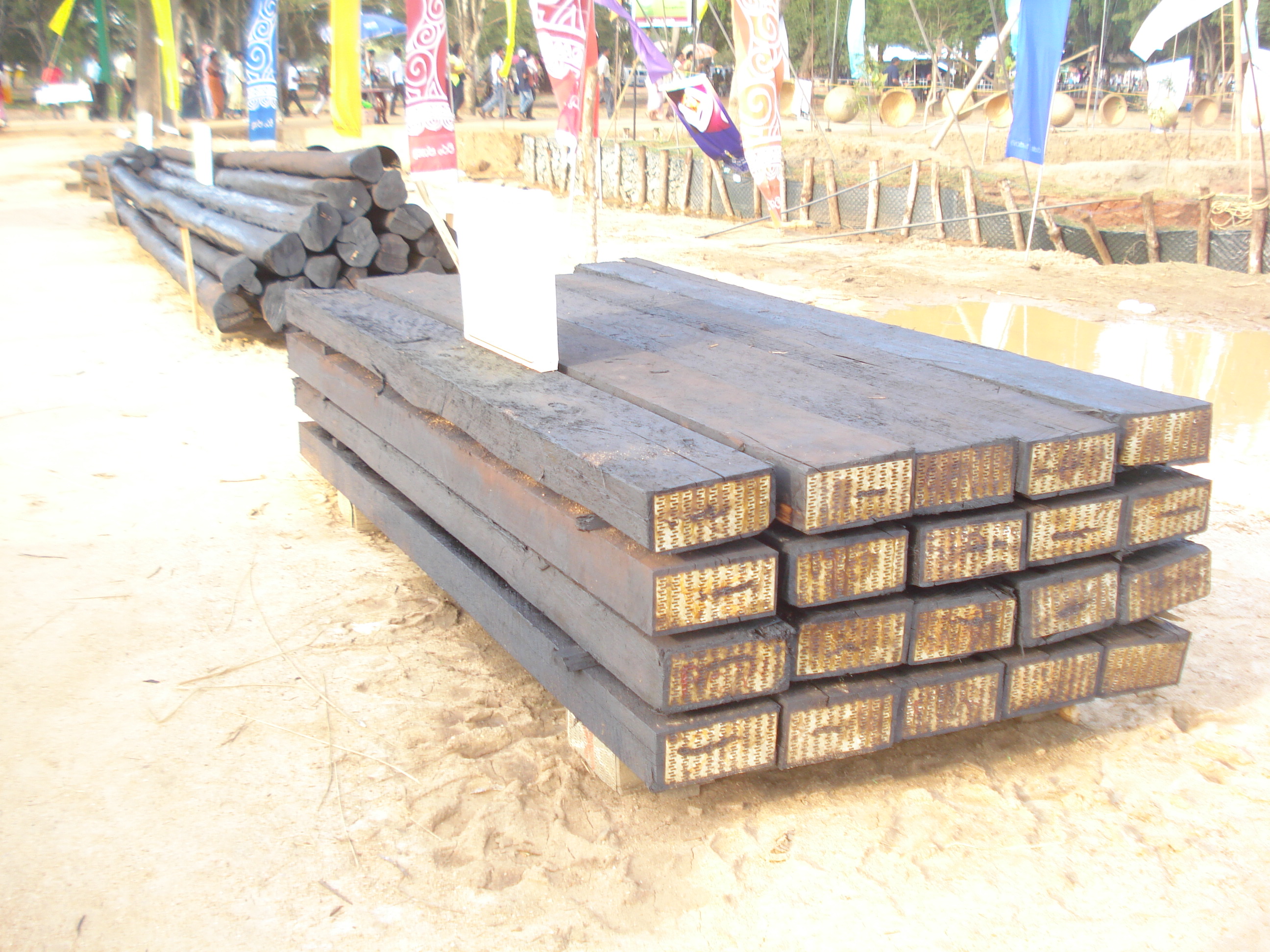
All the treated sleepers and transmission poles in Sri Lanka were preserved with creosote.
Creosote is unsuitable for:
 Use inside some buildings where people live or work.
 Most situations where there is contact with people or animals.
 Wood products in contact with or near food.
  Wood surfaces requiring paint.
Permanent weight gain from creosote treatments can be significant. Retentions vary from 5 to 25 pounds per cubic foot (pcf) of wood.
Specification of Coal tar creosote (Type 2) BS standard
Test / Unit |
Test Method |
Rrsults |
Specificationgiven in BS 144:1997 for Coal Tar Creosorte for Preservation of Timber(Type2) |
01. Density at 38 0C kg/m3 |
BS 144:1997 |
1074 |
|
| 02. Water Content, % v/v. |
BS 144:1997 |
0.3 |
|
| 03. Liquidity at 32 0C for 2 hours |
BS 144 : 1997 |
Completely Liquid |
Marerial shall become completely liquid at 320C |
04. Cumulative distillate % m/m.
205 0C
230 0C
270 0C
315 0C
355 0C
|
BS 144 : 1997 |
|
|
|
05. Extractable Phenol Content ml/100g
Type 1,2 and 4 density range 1046 to 1114 kg/m2 |
BS 144: 1997 |
0.2 |
|
|
| 06. Matter insoluble in Toluene % m/m. |
BS 144: 1997 |
0.2 |
Not more than 0.4 |
| 07. Viscosity Kinematic at 400C , mm2/S |
BS 144: 1997 |
6 |
4 - 20 |
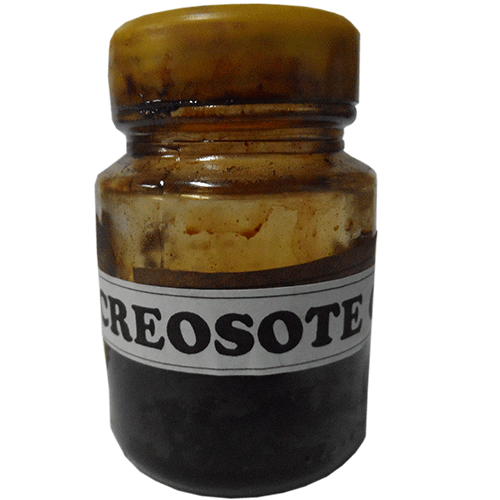
creosote bottle
 treated wood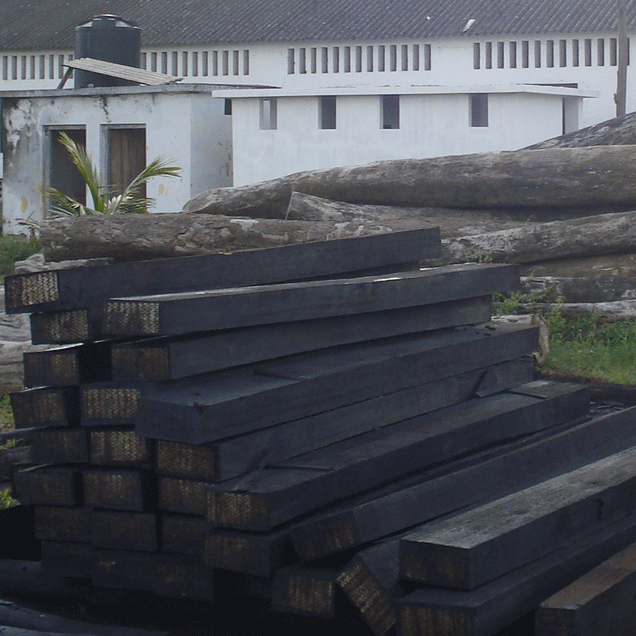
Pentachlorophenol (PCP or penta)
Pentachlorophenol is a crystalline white solidmade in a controlled chemical process. The preservative ability of PCP was discovered around 1935, and was developed into a very successful wood preservative.
Pentachlorophenol is usually dissolved in either light or heavy petroleum oil to produce wood-preserving liquids. It can also be dissolved in water (as ammonium pentachlorophenate) and can be dispersed or emulsified using water as its carrier. Penta can also be added to creosote and petroleum oil mixtures to boost performance.
Penta treating solutions impregnated into wood have a tendency to evaporate, causing blooming (See Table ). Blooming is the formation of crystals on the surfaces of treated wood as a result of exudation and evaporation of the solvent.
Summary of advantages, disadvantages and properties of the restricted-use pesticides creosote, pentachlorophenol and inorganic arsenicals.
Pesticide |
Advantages |
Disadvantages |
Creosote |
01. Excellent protection against fungi,insects and most marine borers.
02. Insoluble in water. 03. Excellent stability, suitable for thermal and Boultonizing processes.
04. Provides excellent water repellency and mechanical stability.
|
01. Poor protection against certain marine borers.
02.. Leaves dark, oily, unpaintable surface.
03. Tendency to bleed or exude from wood surface.
04. Strong odor–cannot be used in homes or other living areas because of toxic fumes. Harmful to plants.
05. Contact with treated wood may cause skin irritation or burns.
06. Heating is required to reduce viscosity.
07. Can ignite, so it must be heated cautiously.
08. Treated wood remains considerably heavier: 25-50% weight increases are common. |
Pentachlorophenol |
01. Excellent protection against fungi and insects.
02. Can be dissolved in oils having a wide range of viscosity, vapor pressure and color.
03. Can be glued or painted depending on carrier.
04.Water repellents can be added to improve weatherability.
05. Good heat stability-butheating Penta is not common.
06. Low weight increase (1-2%) if an evaporating carrier is used. |
01. Poor protection from marine borers.
02. Can leave oily, unpaintable surface, depending on carrier used.
03. Irritating smell, toxic to plants, animals and people.
04. Not suitable for use in homes or other living areas.
05. Contact with treated wood may cause skin burns or irritation.
06. All oil carriers are flammable.
07. Permanent weight increases of 20- 50% if heavy oils are used.Tendency to “bloom” (p. 34)
08. (now banned in Sri Lanka) |
Inorganic arsenicals |
01. Excellent protection against fungi insects and most marine borers.
02. Produces no smell or vapors.
03. Suitable for use indoors.
04. Non-toxic to nearby growing plants.
05. Treated surfaces can be painted.
06. Permanent weight increases of only 1-2% after wood has reseasoned.
|
01. Only moderate protection from pholad marine borers. Will not prevent mildew.
02. Does not protect wood from exces- sive weathering.
03. Not heat stable above 140° F; therefore cannot be used in thermal or Boultonizing process.
04. Temporary weight increases of 20- 90% immediately after treatment. Swells wood when treated, so some seasoning defects may occur when redried.
|
This evaporation is minimized by the inclusion of a nonvolatile liquid in those preservative solutions using an evaporating carrier or solvent. Protection from contact with penta crystals can be accomplished by sealing the dried, treated surfaces with a coating of urethane, shellac, varnish or a latex epoxy enamel. Note: Sodium pentachlorophenate, the water-soluble form of pentachlorophenol, and the closely-related tetrachlorophenol, were once widely used in anti-sapstain dips for treating lumber in sawmills. This treatment and other anti-sapstain chemicals are not covered in this program.
PCP is unsuitable for:
 Most uses inside homes or offices.
 Marine protection of wood.
 Uses where livestock can come in contact with it.
 Wood products in contact with or near food.
Inorganic arsenicals (waterborne preservatives)
The inorganic arsenicals (also called the waterbome preservatives) are a group of preservatives that include chromated copper arsenate (CCA), ammoniacal copper arsenate (ACA), ammoniacal copper zinc arsenate (ACZA), chromated zinc chloride (CZC) and acid copper chromate (ACC).
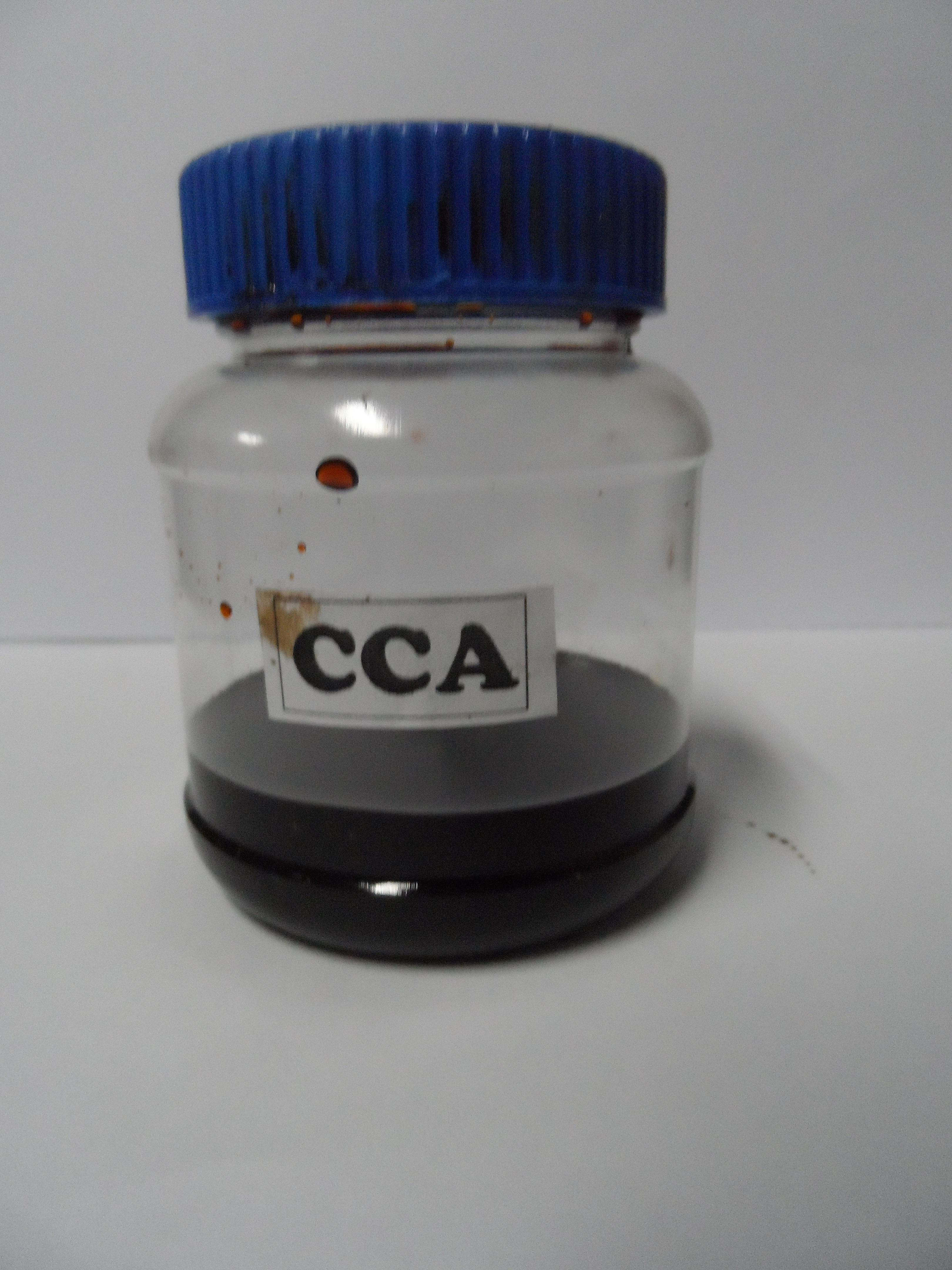
CCA is by far the most widely-used preservative in the Sri Lanka till it was banned in 2002 when Sri Lanka
(large portion of wood products treated with waterbome preservatives were treated with CCA).
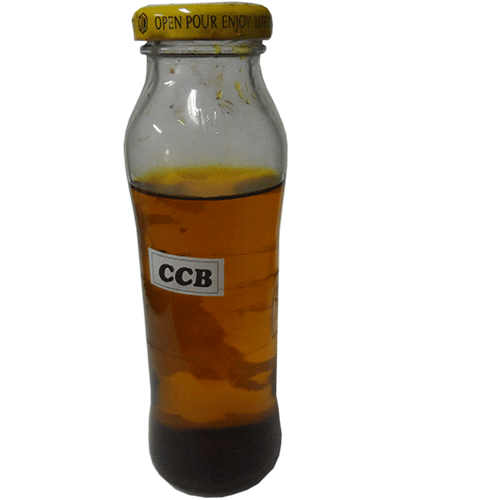
CCB oil
 CCB treated timber
Chromated copper arsenate (CCA).
Copper was known to have preservative properties long before the development and use of CCA. Copper sulfate in water solution is a fairly inexpensive wood preservative, but two factors prevent its widespread use:
1. It is very soluble in water, so it tends to wash or leach out of the treated wood, leaving the wood unprotected.
2. Copper sulfate protects wood from most fungi, but is ineffective against insects such as termites and a few “copper-tolerant” fungi.
The first problem (solubility) was overcome by adding chromates to copper sulfate to “fix” the copper in the wood in an insoluble form. The second fault was corrected by including arsenates with the copper/chromate mix to control both insects and copper-tolerant fungi (See Table ).
International commercial use of CCA preservatives began in the 1950s. They are marketed under several brand names and have become the most versatile of all wood preservatives. Their use is growing in North America, partly at the expense of creosote and pentachlorophenol. Also, more and more treated lumber is being demanded by specifiers and the do-it-yourself market, which usually has limited uses for creosote or penta preservatives.
The weight of wood may double after CCA treatment, but most of the additional weight is water, which evaporates after redrying. The permanent weight of CCA oxides is small, ranging from 0.7 % to 1.8 %, because only 0.25 lb/cu. ft. is required for above-ground use and 0.40 1b/cu. ft. is required for ground-contact use.
As with most preservatives, wood properly treated with CCA shows no significant changes in strength. However, long-duration use of high temperature and/or high pressure during treatment can lower wood strength.
Treatment with CCA initially imparts an orange hue to the wood, then changes to pale green. Other colors may be obtained using color additives before, during or after treatment.
CCA is unsuitable for:
 Wood products in contact with food.
 Preserving railroad crossties.
Creosotes and
PCP in heavy petroleum oil offer crossties more protection against cracking in wet/dry weather cycles.
AWPA standards list three types of CCA which may be used interchangeably throughout the commodity specifications covered. These are CCA types A, B and C, and their differences arise from historical rather than scientific or practical grounds. At present, type C is most widely used. Details of the three types are:
| |
A |
B |
C |
(nominal percent) |
| Copper oxide, |
18,l |
19.6 |
18.5 |
| Chromium trioxide |
65.5 |
35.3 |
47.5 |
| Arsenic pentoxide |
16.4 |
45.1 |
34.0 |
Total |
100.0 |
100.0 |
100.0 |
Note that the copper content of the three types of CCA is similar. The differences lie in the balance between chromium and arsenic.
Ammoniacal copper arsenate (ACA) and ammoniacal copper zinc arsenate (ACZA).
These preservatives are similar to CCA, but do not use chromate as a fixing agent. Instead, copper arsenate is made soluble in water mainly by addition of ammonia. After treatment the ammonia and water evaporate, leaving water-insoluble copper arsenate “fixed” in the wood. Treated wood has an uneven blue/green to brown color.
The ACA preservative (commercially known as Chemonte) was developed on the west coast of U.S., and is mainly used there and in western Canada for pole treatments. Pound for pound it is usually rated equal in performance to CCA.
Other preservatives
There are a number of wood preservatives available, but never assume they all are equally effective. In specifying treated wood for a given purpose, refer to the AWPA standards or federal specifications for acceptable preservatives and treatments.
Copper Naphthenate (oilborne). Copper naphthenate is made by reacting copper salts with naphthenic acid (a petroleum by-product). It is a viscous, dark blue-green liquid, soluble in petroleum solvents and should contain 6–8% copper by weight. It can be produced in a formemulsifiable in water, but is normally dissolved in heavy or light petroleum.
The product is a good wood preservative for preventing decay, and is suitable for ground contact. It’s also safe to use near growing plants (after any volatile solvent used has evaporated). Treated wood has a distinctive green color, but this fades in sunlight. It is used for greenhouse lumber, yard and landscape timbers and seed and mushroom boxes.
Disadvantages are its fairly high cost, lack of protection against termites, persistent “oily” smell and poor ability to take paint or glue. Organic solvent versions are flammable.
Zinc naphthenate (volatile petroleum oilborne). Zinc naphthenate is similar to copper naphthenate but is not as effective a fungicide. It should only be used for above-ground products. The zinc salt does have the advantage of being almost colorless.
Copper-8-quinolinolate (water and volatile petroleum oilborne). Copper-8 (for short) is the only preservative accepted in the U.S. for wood in direct contact with human food. Preservative solutions must be made using a well-refined “odorless” solvent to avoid tainting food. It is normal to add an equal weight of nickel 2-ethylhexoate to the copper-8. The concentrated preservative chemical should contain 1.8% by weight of both copper and nickel.
Copper-8 is quite expensive, but this may be justified for its specialized uses such as for food pallets, wooden vehicle and container bases and in food processing equipment. The liquid is bluish-green and is flammable. It is not suitable for ground contact.
Tributyltin oxide (volatile petroleum oilborne). TBTO is a colorless, watery liquid with a sharp, retentive odor. The tin content, by weight, should be between 38.2% and 40.1 %. This liquid is dissolved in light petroleum solvents and is flammable. It is mainly used in place of pentachlorophenol at concentrations of
0.5 to 1.5% TBTO, where improved paint or glue performance is needed. It is limited to above-ground use such as for millwork and especially for window and door components
Preventing Destruction by Fire and Weathering
Each of the wood preservative chemicals discussed are able to prevent some, or all types of biological degradation of wood. They either interfere with the enzymes promoting decay or are toxic to insect pests.
Biological decay equation:
(Cellulose + Oxygen) + Enzymes = (Carbon Dioxide + Water)
Deterioration of wood by fire and weathering (physical causes) has the same ultimate effect as decay of wood by fungi. The only difference between the biological and physical deterioration processes is the source of energy used. Enzymes trigger the biological (fungal) decay. Physical deterioration from fire relies on heat. The energy for weathering comes from light, wind, rain, frost and heat.
Physical deterioration equation:
(Cellulose + Oxygen) + Heat, etc. = (Carbon Dioxide + Water)
Fire retardant treatments
Neither wood nor any other construction material can withstand prolonged, intense heat without being broken down and eventually destroyed. Nevertheless, we try to minimize structural failure to safeguard life and property. Chemical protection of wood from damage by fire is accomplished with fire retardant treatments (FRT). Fire retardant formulations areused to change the behavior of wood in a fire. Certain chemicals, especially ammonium salts, borates, phosphates, bromides and antimony oxides can help to prevent or reduce ignition of wood and flaming of wood surfaces.
Fire retardant chemicals also help to increase charring. Char, a porous, low-density form of black carbon, is an excellent thermal insulator. If the outer 1/2” of wood in a heavy beam can be converted to char, the undamaged wood underneath will probably keep its strength in a fire lasting an hour or more. Such maintenance of a beam’s strength can help safeguard occupants from sudden structural collapse.
These chemicals also reduce smoke production and prevent flames from starting. Fire retardants may not save the wood in its original form, but they can certainly save people and property by delaying the spread of fire. Firefighters also benefit from FRT wood materials because they generally have a smaller fire to deal with.
Water-repellent finishes
Wood exposed to the weather is adversely affected by the sun’s heat and ultraviolet rays, rain, ice, wind and dust. Birds may peck holes in outdoor wood, and fiber-using insects (for example, wasps) may remove the surface fibers to build “paper” nests.
Despite this awesome list of weathering factors, outdoor wood can be protected by coating exposed surfaces with one or two coats of a pigmented, water-repellent finish usually containing waxes and resins. Waxes and resins stabilize the surface fibers, prevent wetting by rain and hold pigments on the wood surface. Pigments give color and absorb heat and harmful ultraviolet rays that otherwise would bleach the wood of its natural color and accelerate break-down of the surface layers.
Water-repellent treatments are not defined in the AWPA standards, but several good proprietary brands of transparent wood finishes are available in home improvement and paint stores. If applied in one or more coats, these finishes do not form a discrete film on the wood surface as paints or varnishes do. Therefore, they are not likely to peel or flake, and are more easily maintained over the years.
Health and Safety Factors
In the late 1970s, the Environmental Protection Agency (EPA) studied the three major groups of wood preservatives in terms of their risks to the environment, to treaters and to users of the treated wood. This study covered creosotes, pentachlorophenol-based preservatives and waterbome or arsenical preservatives. The EPA’s study determined that all three classes of preservatives could damage the health of people, plants and animals in contact with the preservatives or in close proximity to a treating plant. The first significant document issued was called a Rebuttable Presumption Against Registration, or RPAR, issued in 1978. Nearly sixyears of study, discussion and lobbying followed; before the EPA published its findings about the three types of preservatives in its
Position Document #4 or PD-4, issued inJuly 1984.
PD-4 concluded that:
1. Each class of preservative studied is capable of adversely affecting the health of people producing or using the treated wood and other people indirectly by vapors from treating plants or by contaminated groundwater, etc.
2. Each preservative plays a significant part in conserving the U.S. timber resources by preventing early decay of wood in homes and other buildings, fencing, poles and crossties, thereby greatly benefiting the nation.
3. Ways could be found to allow the continued use of all three types of preservatives but tighter restrictions on handling, labeling and treatment site practices would be needed. The industry was also required to develop a Con-sumer Awareness Program (CAP) and to provide Consumer Information Sheets (CISs) with all sales or deliveries of treated wood. This requirement later became a voluntary request.
After further discussion between the EPA and the wood-preserving industry, a detailed agreement was reached. This covered changes in practices to protect the treater, the end user and the environment.
¬ read more
 Some species, once abundant (for example, Satin, Palu, ebony, Milla), have been overused and exported due to its high demand, today find low scale.
  After harvesting, virgin forestland that once grew durable species has been converted to homeland or replaced with non-durable tree species.
  Naturally durable trees are typically older trees, but the young, fast growing trees that replace the old trees have higher proportions of sapwood which has no natural durability.(Albizia spp)
  The worlds human population has doubled in just the last 40 years, creating tremendous demands on our forest resources.